Front Page

Tsai calls for Taiwan-Japan talks on security

Focus Taiwan
Date: 2019/03/02
By: Wen Kuei-hsiang, Yang Ming-chu, Yeh Su-ping and Chung Yu-chen 

Taipei, March 2 (CNA) President Tsai Ing-wen (蔡英文) has said she would welcome dialogue with Japan at the governmental level to discuss security, according to an exclusive interview published Saturday in the Sankei Shimbun.

The Japanese newspaper noted that there is no direct dialogue or framework for cooperation between Taiwan and Japan in areas such as security and there is no move toward that at the moment.

The main reasons are that Beijing claims “Taiwan as an inseparable part of China” and there are no diplomatic ties between Taiwan and Japan, the paper said.

A substantive cooperation between Taiwan and Japan is necessary, particularly on the security threats in East Asia, Tsai said in the interview.    [FULL  STORY]

Youth retinal detachment more prevalent in Taiwan

Taipei Times
Date: Mar 02, 2019
By: Lin Hui-chin, Wu Liang-yi and Jake Chung  /  Staff reporters, with staff writer

The high rate of myopia among young Taiwanese could be the main contributing factor to an increase in

An ophthalmologist examines a patient in Taipei on Thursday.Photo: Lin Huei-chin, Taipei Times

retinal detachments, doctors said, citing National Health Insurance Administration statistics.

Retinal detachment is more prevalent in Taiwan than in other nations, especially among those aged 20 to 30, research by Kaohsiung Chang Gung Memorial Hospital Department of Ophthalmology doctor Wu Pei-chang (吳佩昌) showed.

Thirteen times more people in the age group have the condition compared with the Netherlands, Wu said, adding that the agency’s statistics showed that more than 100 young people undergo surgery for retinal detachment every year.

The high prevalence of retinal detachment is directly related to the large number of people with high myopia, Wu said.    [FULL  STORY]

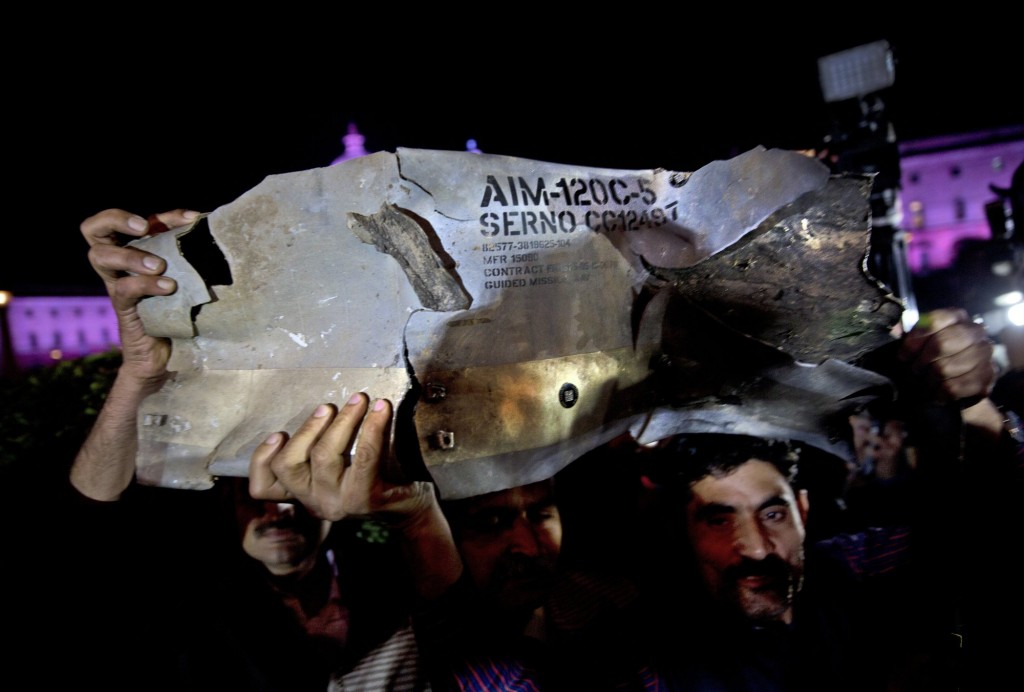
Missile shown by India actually sold by U.S. to Taiwan: Pakistan media

Air Force denies Pakistani media reports

Taiwan News
Date: 2019/03/01
By: Matthew Strong, Taiwan News, Staff Writer

Pakistani media claim a missile displayed by India was sold to Taiwan by the U.S. (By Associated Press)

UPDATE: Air Force denies missile is owned by Taiwan

TAIPEI (Taiwan News) – A missile shown in a picture by India as having been fired by Pakistan using its F-16 fighter jets in a surprise attack this week actually belonged to Taiwan, according to Pakistani media reports, but the island nation’s Air Force said the identification numbers did not match.

Pakistan shot down an Indian MiG-21 jet and captured its pilot and India took down a Pakistani military aircraft after India attacked militants in its traditional Muslim-dominated rival.

On Thursday, the Indian military showed a photo of the remains of a United States-made missile which it said could only have been fired from an F-16 fighter jet. The issue is sensitive because the U.S.-delivered jets can reportedly only be used against terrorists, not against other countries.

However, on Thursday, the Pakistani publication The Express Tribune reported the wreckage could have been part of a missile sold by the U.S. to Taiwan. The reporters tracked the identification numbers shown in the picture, AIM-120C-5 AMRAAM, to a U.S. Department of Defense list naming the missile as part of a US$2.38-million arms deal with Taiwan.    [FULL  STORY]

Hsieh Hsueh-hung: Taiwan’s Communist Champion of Self-Determination

Remembering her life, her heroism during the 1947 uprising, and the legacy of the communist movement in Taiwan

The News Lens
Date: 2019/03/01
By: Antonia Finnane, The Conversation

Every so often a woman takes up arms to lead a spirited struggle against invaders and occupiers of her

Credit: Wikimedia Commons

homeland. Such women usually wind up dead at an early age, but they capture the imagination. The most famous example in British history is Boudica, aka Boedicea; in French history, it is Joan of Arc.

The Taiwanese revolutionary Hsieh Hsueh-hung (謝雪紅) is such a figure, although like most aspects of Taiwan’s history her significance is contested. Born in Taiwan, buried in Beijing, Hsieh was a communist and also an advocate of Taiwanese self-determination. In the history of world communism she is noted for being one of the founders of the Taiwanese Communist Party, established in 1928.

In the annals of the Taiwan independence movement, Hsieh has emerged as a heroine of the 1947 uprising, now the subject of an annual commemoration held in Taiwan on Feb. 28. In 1948 she founded the Taiwan Democratic Self-Government Alliance.

Hsieh Hsueh-hung’s fate – in life and in death – was determined by the shifts in attitude towards Taiwanese independence on the part of ruling powers, and by the status of its local left-wing movements. To some degree, she is not so much a woman hidden in history as one rendered visible by it.    [FULL  STORY]

Vietnamese visitor repatriated after failing to pay pork fine

Focus Taiwan
Date: 2019/03/01
By: Yang Su-min and Chung Yu-chen

Photo courtesy of BAPHIQ

Taipei, March 1 (CNA) A visitor from Vietnam, an African swine fever (ASF)-affected country, was repatriated Wednesday after failing to pay a fine for attempting to bring pork products into Taiwan.

According to the Bureau of Animal and Plant Health Inspection and Quarantine (BAPHIQ), the Vietnamese national was fined NT$200,000 (US$6,488) for failing to declare sticky rice dumplings at customs.

The woman, who arrived at Taichung Airport in central Taiwan on Wednesday and repatriated the same day, is the first visitor to be repatriated since Taiwan expanded penalties on Feb. 15 against travelers who bring pork products into the country from Vietnam, said BAPHIQ.

The pork dumplings will be tested for ASF after the 228 Peace Memorial Day long-weekend holiday, BAPHIQ official Peng Ming-hsing (彭明興) said, adding the result is expected within 2 days.
[FULL  STORY]

The 228 Incident Remains Etched Into Taiwan’s Present and Its Future

Here’s what Taiwanese lawmakers and thinkers are saying on the 72nd anniversary of the 228 Incident.

The News Lens
Date: 2019/02/28
By: Nick Aspinwall

Credit: Public Domain

Today marks 72 years since Feb. 28, 1947, when protests, spurred by a clash between government officials and an illegal cigarette vendor in Taipei one day earlier, were met with gunfire. The 228 Incident led to a popular uprising met by a violent three-month crackdown which killed an estimated 18,000 to 28,000 people – although this number may be higher – and led to the 38-year, 57-day period of martial law in Taiwan known as the White Terror.

It is important to remember why Taiwan is off from work today. This piece by James X. Morris at The Diplomat is an excellent dive into the history of the 228 Incident. Here at The News Lens, be sure to take a look at this list of facts about 228 you should know. And today, as we hear politicians remember Taiwan’s period of torment and celebrate its remarkable transition into democracy, it is crucial to look at how the 228 Incident, and the subsequent period of White Terror, continue to shape Taiwan today.

Credit: Nick AspinwallA wall shows victims of 228 at Taipei’s National 228 Memorial Museum. Photos have not been found to match the names of many victims.
Continuing the search for the truth
On Wednesday, President Tsai Ing-wen (蔡英文) told an overseas group of family members of victims of the 228 Incident that “we will never forget and we will not stop” seeking the truth. The government will continue to seek to identify potential unrecorded victims of the 228 Incident, she said.

An investigative report on the 1947 crackdown is set to be released in July by the Memorial Foundation of 228, according to its chairman, Hsueh Hua-yuan (薛化元). The foundation is compiling a list of about 2,000 previously unknown victims of the 228 Incident which will be made public before the end of this year, Hsueh said.    [FULL  STORY]

Taiwan’s police officer helps sick woman with chocolate

Upon seeing the woman’s physical condition, Lin took out chocolate from his police coat and gave it to her to eat

Taiwan News 
Date: 2019/02/28
By: George Liao, Taiwan News, Staff Writer

Police officer Lin Ting-wei (right) (photo courtesy of Pingzhen Precinct/CNA)

TAIPEI (Taiwan News) — A Taoyuan police officer on Thursday morning helped a woman lying by the roadside looking pale by giving her chocolate and calling an ambulance as the officer suspected that the woman was suffering from low blood sugar, Central News Agency (CNA) reported on Thursday.

Pingzhen Precinct said that officer Lin Ting-wei (林庭瑋) and another officer were carrying out patrol duties on Thursday morning when they found the woman lying by the roadside, according to CNA. The officers got out of their car to investigate and found that the woman was shivering all over, supposedly suffering from low blood sugar levels, the news outlet reported.

Upon seeing the woman’s physical condition, Lin took out chocolate from his police coat and gave it to her to eat, then called an ambulance, CNA reported.

The woman surnamed Chen told the officers that she was riding her bicycle on her way home from her morning’s work on a farm when she felt dizzy and fell into the grass by the road along with her bicycle, according to the report.    [FULL  STORY]

Transitional justice will ensure Taiwanese live censor-free: Tsai

Focus Taiwan
Date: 2019/02/28
By: Joseph Yeh

Taipei, Feb. 28 (CNA) The government’s ongoing push for transitional justice is intended to ensure

President Tsai Ing-wen (蔡英文)/CNA file photo

Taiwanese can live in a censor-free society without fear of ever again being punished by an authoritarian government, President Tsai Ing-wen (蔡英文) said Thursday, during a memorial ceremony to mark the 72nd anniversary of the 228 Incident.

Speaking at the ceremony in Taipei’s 228 Peace Memorial Park, Tsai said as she arrived at the park, she saw many young children and their parents enjoying a day off thanks to the national holiday.

The administration is pushing to implement transitional justice to ensure all Taiwanese live in a censor-free society “where people can read whatever they like and express their views without fear of being taken away by police in the middle of the night,” she said, as happened to many during the brutal crackdown on an anti-government uprising in 1947 and the decades-long White Terror era that followed.

The 228 Incident was triggered by a clash between government officials and an illegal cigarette vendor in Taipei on Feb. 27, 1947, leading to protests a day later that were violently suppressed.    [FULL  STORY]

Government protecting freedom: Tsai

‘INSUFFICIENT UNDERSTANDING’: The president said that a list of possible victims whose families have not filed for compensation demonstrates the gaps in historical facts

Taipei Times
Date: Mar 01, 2019
By: Staff writer, with CNA

The government’s ongoing push for transitional justice is intended to ensure that Taiwanese can live in a

President Tsai Ing-wen, second right, yesterday comforts Wang Mei-hua, the daughter of Wang Fu, a victim of the 228 Incident, during a ceremony to restore Wang Fu’s innocence at the 228 Peace Memorial Park in Taipei.  Photo: CNA

censor-free society without fear of being punished by an authoritarian government, President Tsai Ing-wen (蔡英文) said yesterday at a memorial ceremony to mark the 72nd anniversary of the 228 Incident.

Tsai said that as she arrived at the ceremony at Taipei’s 228 Peace Memorial Park she saw many young children and their parents enjoying a day off due to the national holiday.

The government is pushing to implement transitional justice to ensure that all Taiwanese live in a censor-free society “where people can read whatever they like and express their views without fear of being taken away by police in the middle of the night,” she said, referring to what happened to many during a brutal crackdown on an anti-government uprising in 1947 and the decades-long White Terror era that followed.

The 228 Incident was triggered by a clash between government officials and an illegal cigarette vendor in Taipei on Feb. 27, 1947, leading to protests a day later that were violently suppressed.    [FULL  STORY]

OPINION: Should Tsai Address US Congress? Let’s Ask the People of Taiwan

The brunt of any consequences, positive or negative, to Tsai addressing US Congress would be felt by the people of Taiwan.

The News Lens
Date: 2019/02/27
By: Milo Hsieh

Credit: Depositphotos

In an opinion article published in The Hill on Jan. 21, Taiwan and China expert Joseph Bosco proposed that Taiwan President Tsai Ing-wen (蔡英文) should be invited to speak in front of a joint session of U.S. Congress. Soon after, several Republican senators asked Speaker of the House Nancy Pelosi to extend an invitation to Tsai – including Senators Ted Cruz and Marco Rubio, both of whom have traditionally advocated for Taiwan and opposed Chinese pressure on Taiwan’s government and international presence.

The reasons are clear: In 2019, the U.S. ought to move towards a more normalized relationship with Taiwan. As former Dutch diplomat Gerrit van der Wees writes in The Diplomat, though Western powers such as the U.S. and EU applaud Taiwan’s democracy, “their antiquated policies are still stuck in the 1970s.” (The U.S. switched its diplomatic recognition from Taipei to Beijing in 1979 at a time when the Republic of China (ROC) was governed under martial law.)

Despite this, the U.S. remains in nominal compliance with the “one China policy” and engages in restricted diplomatic contact with Taipei, often toeing the line between angering China and continuing U.S. commitment to Taiwan.

Bosco and Van der Wees are right: the lack of normalized relations and codified commitment between Taiwan and the U.S. is indeed an important issue as the U.S. attempts to pivot to the Indo-Pacific region in order to counterbalance the rise of China.    [FULL  STORY]